[Chris]
As mentioned previously, feel free to skip this post if it has too much detail or too many photos. There are just so many amazing pieces, and we didn't even capture half of them.
Waterford is home to the Waterford Crystal company, the premiere cut-glass maker in the world. You've probably heard of them. Not only do they make very expensive dinnerware and vases, they also produce custom pieces for heads of state, celebrities, other gazillionaires, cathedrals, Super Bowls, 9/11, and of course the NYE Ball Drop.
They offer a factory tour, so of course we had to do that. I knew "Waterford Crystal" was a fancy brand, or maybe a type of fancy glass, but I had no idea it was made in Ireland, or even that there was a city Waterford, Ireland. Now that I've seen it made, I will certainly feel a connection to it in the future.
By the way, if after reading this post you are curious whether or not you own a piece of Waterford crystal, apparently every piece is acid-etched with their name and/or a seahorse logo.
 |
| They have 1783 listed as their start date, but they don't advertise that they
closed during the Great Potato Famine of the 1840s for over 100 years. And
then I think they briefly closed again after going bankrupt in 2009
after the recession and being acquired by Deloitte, but are now thriving in the center of town after
being purchased in 2015 by Fiskars. Their headquarters here are the
home of their custom hand-cut commissioned work, while they have a plant in
Slovenia that does the higher volume manufacturing. |
 |
| Both the company and the town were beautiful |
 |
| Okay, Step 1: the glass is pulled out of the oven around 1200 F, and the craftsman shapes the glass roughly into an 3D oval (a prolate spheroid, if you prefer) using a wooden shaping tool in his right hand that's a lot like a ladle. I don't think it has to be very precise yet. |
 |
| Step 2: repeat Step 1. Put it back in the oven (this time to 1500 F), and shape it again. I believe the small blob is still solid here. |
 |
| Step 3: The blob is put into a mold (here cast iron) and the craftsman blows down the rod, inflating the glass like a balloon into the mold. He spins the glass as he does this, and his rod is hollow with a mouthpiece on the end. Each person seems to have his own mouthpiece for obvious reasons. Apparently they get a feel for the completeness based on the resistance they feel in their lungs. |
 |
| This is a wooden mold. |
 |
| Step 4: The piece is removed from the mold, and it's annealed (reheated to 1000 F) under this flame to release tensions in the glass. Note, I think the right/top lobe of the glass, attached to the rod, is overflow from the mold. I think only the bottom lobe is the final piece. But I'm not positive. |
 |
| Step 5: A water jet is sprayed
onto the end of the rod (you can see the cap of the rod is no longer glowing red compared to the previous picture), and when the glass cools enough, it just snaps
off from the rod and falls onto the leather surface. Steps 1-5 took
about 5-10 minutes from start to finish. I honestly have trouble
believing that this manual process using wood and human lungs produces
usable shapes to meet the Waterford quality standard! |
 |
| Step 6: the hot piece is placed into a morgue-like drawer to cool overnight under a towel. It will continue being processed in the morning. I believe they make hundreds per day. |
 |
| The next day, the pieces are pulled from the back of the drawers (left wall) and finished and inspected (note, finished does not mean finished - we've barely started. It means cleaned up). The mold overflow is cut off, the glass is sanded and cleaned, and any defects mean the piece has to be melted down and remade. Common defects are inclusions, scratches, bubbles, cloudiness, uneven wall thickness. There are no Waterford outlet/imperfects/seconds stores - it needs to be perfect, or it's melted down to start again. |
 |
| An illustration of the upcoming steps, from right to left (since the tour walks from right to left). Note, everything so far has been Step A (glassblowing and finishing). No one buys plain bowls from Waterford. Now the artistry starts. |
 |
| Every pattern has a CAD drawing. It's neat to see this level of precision, and geometry, in art. |
 |
| Step B: Marking. This is done by hand using some simple but effective tools. The bowl is mounted on a turntable with degree markings, and you can see the Sharpie is mounted to a block, which is pressed against a large vertical plate. He turns the bowl a set number of degrees, and then slides the Sharpie down the plate for a perfectly repeated vertical line on the glass. |
 |
| Here is another marking station. This time you can see the Sharpies on clamps, so that when the piece turns, horizontal lines are drawn at the right distances. Again, simple but effective, and you can see the CAD measurements on the paper below. You can also see the self-centering grips built into the blue plate. Note, for more custom artistic designs, the marking is done freehand. |
 |
| Step C: Cutting. This is the most mind-blowing step. There is a vertical diamond wheel spinning at a high RPM, and the operator holds the glass against the wheel to cut the grooves/bevels/facets where the Sharpie lines are. ALL. BY. HAND/EYE. Operators are trained for 5+3 years before they can work on their own. And they have to produce an apprentice bowl, which includes all of the cuts, to pass. |
 |
| Quite the selection of cutting wheels for different angles, depths, sizes, etc. |
 |
| Note, there is a CNC machine which is used for certain cuts that just can't be made by humans (like circular cuts). They said 10% of parts are automated, and 90% are done by hand. At least here in Ireland, for the custom pieces. I'm not sure how the standard fare is made in Slovenia. |
 |
| Close up of the CNC wheel, with water cooling the part and collecting the glass dust. |
The remaining Step D (not shown, nor part of the tour) is the polishing stage. This is done with a mixture of hydrochloric and sulfuric acid to take off the sharp edges and make the cut glass sparkle like cut diamonds. If you go back to the picture of the 4 bowls/steps above, you can see how much better the left bowl looks after polishing.
Okay, every thing shown so far is for hollow pieces (glasses, vases, bowls) with repeating geometric patterns. But much of the custom award-winning work is solid glass, which undergoes two steps before polishing: sculpting and/or engraving.
 |
| We had a great demonstration from this guy making an eagle. There is a lot to see in this image. On the black box on the left (his right) is the finished sculpture he is making. Since it is solid glass, he starts with a glass block rather than blown glass. You can see his paper forms in the lower right. He tapes the torso form onto the block, and cuts and grinds the block to the approximate shape, which he is pointing to with his right hand. In front of his left arm you can see the base of the sculpture that the eagle will be glued to. At the front of the table, you can see an eagle torso in a more completed state, with feathers engraved. If you look closely, you can see the "flat cuts" where the wings will be glued. |
.
.
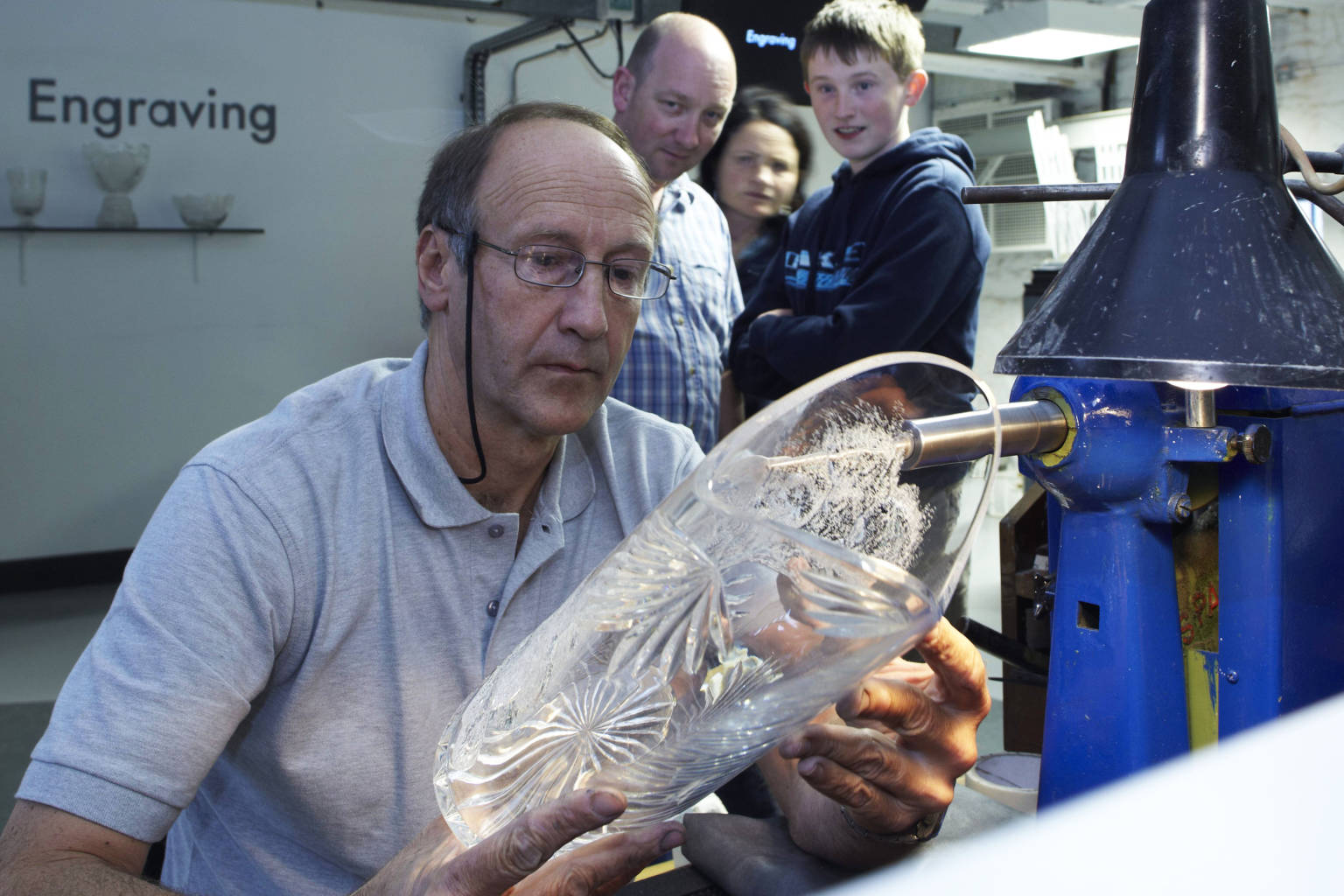 |
| We did not get to see the engraving process, so this is a stock image and that is not our family. It looks like there is a high speed burr that he is holding the glass up to. |
 |
| This is one of the 2700 panels that go into the 12-foot, 6-ton New Years Eve ball in Times Square. The current design is a geodesic sphere assembled from a lot of small flat triangles. Each year they inspect the ball and replace any panels that were damaged. You didn't hear it from us, but in November they will be announcing a new top-secret ball design that will be truly spherical (the panels are rounded segments of a sphere, not flat triangles) |
 |
| Okay, the rest of the photos are Waterford products that are jaw-dropping in their intricacy. Note the numbers on the dial. Not sure if the dial turns. Having seen the tour, I can't even imagine the effort that went into all these cuts. I would have assumed the glass was just cast in a mold or something. |
 |
| Presumably this was engraved more than sculpted. |
 |
| A Viking helmet, and the seal of Waterford in the background. The inscription reads Urbs Intacta Manet (The City Remains Unconquered) referring to its strong military history in the Viking and Norman eras, although Cromwell ($%#!) did eventually conquer the city in his second attempt, always the buzzkill. |
 |
| Go Dutch! I just read that Van Gogh produced about 2100 paintings in 10 years, which is about 1 per weekday! Amazing that a few are so valuable. Also amazing is that he was only able to sell one piece before he died. Oops, sorry for that tangent. |
 |
| The company/city produced a lot of pieces for various 9/11 memorials, and as a result has a piece of the fallen towers in its town square. |
 |
| We have now entered the showroom/giftshop. This stunning piece is for sale for a couple thousand dollars. |
 |
| This is a map of constellations. |
 |
| Even though it may look small, this is a life-size saxophone. I think some of the hinged mechanisms might work. This piece was about $30,000. |
 |
| A half-size harp, about the size of the saxophone. You may recall this is the national symbol of Ireland. It has strings, but I don't think it is designed to be played. |
 |
| I mean come on. How is this real? The clock mechanism is from the Waterford watchmaker in the 1700s; it was restored and encased in crystal 200 years later. |
 |
| This piece was interesting, not just because I love chess boards, but because it wasn't technically made by Waterford. One of their master cutters retired in 2009 when the company went bankrupt, but he kept making things as a hobby. So he has a little open workshop in City Hall, although he rarely comes in any more (if he retired almost 20 years ago he's probably in his 80s), and I don't think he is viewed as a competitor by Waterford, perhaps more of an ambassador. He also did the 9/11 piece above. |


